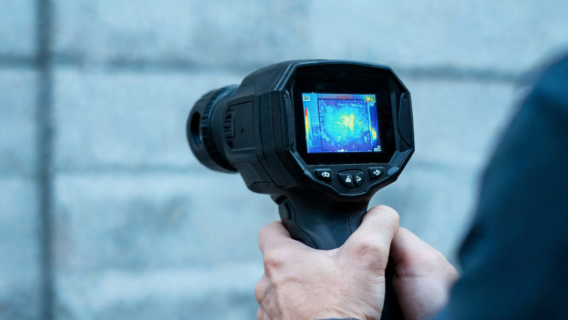
My house is drafty and hard to heat, it is difficult to get it above 17-18 degrees on cold days even if the central heating has been on for quite awhile. The team at Building Energy Experts were very professional, explained what they were doing as they went along. The assessment was very useful, they have identified areas of air leakage etc and quick wins I can make. It has helped me prioritise my budget. I would definitely recommend using Building Experts.
David Butler, Homeowner – Retrofit West Advanced Air Tightness Test & Thermal Imaging
From draughty rooms to failing EPC ratings – find out exactly where your building is losing heat with a thermographic survey.
Heat loss is one of the most expensive problems in a building precisely because it’s invisible – draughts, missing insulation and thermal bridging all drive up energy bills and carbon footprint long before anyone can see where the problem actually is. Left undiagnosed, that same invisibility can undermine anything from a homeowner’s retrofit budget, to a live commercial building’s energy performance, to a new-build’s BREEAM certification.
Our in-house trained thermography team uses calibrated infrared cameras to build an evidenced picture of a building’s real thermal performance, then processes every image using FLIR software to make sure the underlying data is accurate before it ever reaches a report – translating that analysis into a clear, prioritised set of findings you can actually act on, not just a wall of colour with no interpretation. Learn more in our FAQ section below.
Why work with us?
Experience
From identifying missing loft insulation and thermal bridging in a single Bristol home, to producing BREEAM-compliant thermographic evidence for the University of Bristol Veterinary School’s new Blagdon Building, to running overnight surveys across the live, fully-trading Marlowes Shopping Centre in Hertfordshire – our BREEAM-qualified thermographers are as comfortable diagnosing a single cold spot as they are delivering standards-compliant evidence at commercial scale.
Award-winning
Winner, Consultancy – 2025 Bristol Property Awards
Winner, Supply Chain Partner of the Year – 2025 Unlock Net Zero Awards.
Winner, Retrofit Assessor of the Year – 2023 Retrofit Academy Awards.
Highly Commended, Employer of the Year – 2023 Retrofit Academy Awards.
Speed
Project deadlines matter. We manage all data collection, imaging and reporting in-house – keeping your project moving without administrative delays.
We work to a standard two-week turnaround, with the majority of reports and certificates delivered well within that window.
Pricing
Cost depends on the scale and complexity of the project – from a single property to a large-scale portfolio.
Our rate card is reviewed regularly, so we’re confident you won’t find better value elsewhere. If you’ve found a lower quote for comparable work, let us know – we’ll match or beat it.
Support
Energy efficiency, decarbonisation and building regulation can be genuinely complex.
We’ve worked hard to explain a range of topics related to thermographic surveys in plain English to help non-experts get the information they need.
Get Your Thermographic Survey Quote Today
Looking for a fast and reliable thermographic survey in Bristol or the surrounding areas?
Contact us today for a free quote and to discuss your specific project requirements.
Building Energy Experts provided invaluable guidance on our journey to reduce our environmental impact. Their comprehensive survey quickly identified key areas where we were losing energy and helped us prioritise the most cost-effective solutions. With their support, we’re now able to make informed decisions about our energy upgrades and are well on our way to achieving our sustainability goals.
The Green Impact Team, Horfield Health Centre – Commercial Energy Survey & Testing
The service you provided was very helpful in informing our understanding of the building and the design stage, with good communication and availability for follow-up queries following receipt of your report.
Hilary Kolinsky, Studio Skein – PAS 2038 Assessment, Testing & Commercial EPC
Surveying an active shopping centre is logistically complex, but Building Energy Experts handled it with precision. Their report cut through the environmental variables to provide a clear distinction between maintenance quick-wins, like resealing doors, and the capital investment needed for insulation. It provided the exact technical evidence required to inform our roadmap to an EPC B rating and justify the retrofit budget.
Philip Emsley, UEC Energy – Thermographic Survey
Thoughtful, fast-growing force in sustainable consultancy harnessing analytical theory to deliver multiple projects. Rightly gaining national recognition.
Judges, Bristol Property Awards 2025
Understanding Thermographic Surveys: Your Questions Answered
What is a thermographic survey?
A thermographic survey, also known as thermal imaging, uses a special infrared camera to see temperature differences across the surfaces of a building. This creates a “heat map” (or thermogram) that visually shows where a building is losing heat. It’s a non-invasive way to pinpoint problems like missing or defective insulation, air leakage pathways (draughts), cold bridging and even potential moisture issues.
When is the best time to get a thermographic survey?
To get accurate results, surveys need a temperature difference (ΔT) of at least 10°C between inside and outside, which is why they’re typically carried out during the colder months (November to April). Surveys also need to avoid solar loading, where the sun warms external walls and masks real thermal leaks.
Timing can get more complex on live sites: for The Marlowes Shopping Centre, which remained fully trading throughout, we ran the survey across two separate overnight sessions to eliminate solar loading and secure a reliable temperature differential.
What conditions are needed for an accurate survey?
Besides the 10°C temperature difference, several other conditions are required:
– The building should not have been in direct sunlight for at least 4 hours before the survey.
– There should be no rain or snow just before or during the survey, and the building’s surfaces must be dry.
– Wind speeds should be low (below 10m/s).
To ensure these conditions are met, surveys are often conducted in the early morning, late afternoon or at night.
How should I prepare my property before the thermographer arrives?
For the clearest results, keep your heating running continuously for at least 2-4 hours before the survey, aiming for an indoor temperature of 20°C or higher. Keep all windows and external doors closed, and draw back curtains or clear anything blocking access to external walls.
Why should I combine thermal imaging with an air tightness test?
Thermal imaging on its own reveals missing insulation and cold bridging, but pairing it with an air tightness test gives a genuinely complete diagnostic picture. Depressurising the building pulls cold outside air through gaps and structural cracks that wouldn’t otherwise be visible, making draught pathways show up clearly under the infrared camera.
How does a thermographic survey help with sustainability?
By identifying exactly where energy is being wasted, a thermographic survey can change the whole direction of a decarbonisation plan – not just confirm it. At Horfield Health Centre, thermal imaging (combined with air tightness testing and a cavity wall inspection) revealed inconsistent insulation and leakage at the eaves, roofline, windows and doors. That evidence proved critical: modelling showed that installing an air source heat pump on the building as it stood would actually have increased running costs by around £6,000 a year, because the fabric was too poor for the heat pump to run efficiently. Fixing the fabric first, informed directly by the thermal imaging, was the only way the heating upgrade would ever pay off.
What makes your thermographic reports different from a basic infrared camera sweep?
A basic thermal camera only shows surface temperature patterns, which can easily be misread due to reflection or other atmospheric variables. We use calibrated cameras and process every image through FLIR software to verify the underlying temperature data, then interpret it rather than handing it over as-is. At The Marlowes Shopping Centre, that interpretation work was the whole point: rather than treating every anomaly at face value, our thermographer filtered out transient effects to separate low-cost maintenance quick-wins (resealing door and window frames) from the capital works actually needed (insulation, thermal bridging) – giving a prioritised, actionable breakdown instead of a wall of colour with no context.
Why would I need a thermal imaging survey?
1. Improving Energy Efficiency – seeing exactly where heat is escaping lets you target specific areas for improvement, such as adding insulation or sealing draughts, reducing your energy bills.
Enhancing Comfort. Fixing the issues identified in a survey helps eliminate cold spots and draughts, creating a more stable, comfortable temperature all year round.
2. Early Problem Detection – the survey can catch issues like insulation faults or moisture ingress before they become major problems. During a thermographic survey at The Marlowes Shopping Centre, a cold patch on the roof above the management suite flagged a likely water ingress risk ahead of any visible internal damage, catching a moisture issue early enough to prevent more costly structural damage down the line.
3. Quality Assurance – if you’ve had insulation installed, a thermal survey can verify it was done correctly and is performing as it should.
4. BREEAM Compliance – for new builds and commercial projects, a BREEAM-compliant thermographic survey can help you achieve credits under the BREEAM sustainability assessment scheme. On the University of Bristol Veterinary School’s Blagdon Building, our thermal imaging found good continuity of insulation across the building’s external elevations and internal-to-external junctions, with no significant construction defects, directly supporting the project’s pursuit of a BREEAM thermographic credit.
Can thermography be used on listed or heritage buildings?
Yes – thermography is entirely non-invasive, making it one of the safest diagnostic options for heritage, listed or otherwise sensitive structures where more invasive testing methods aren’t appropriate. For the Churches Conservation Trust’s St Paul’s Church, a Grade I listed Georgian building in Bristol, we used thermography alongside depressurisation air testing to trace air movement through the historic fabric – achieving the same visibility the original brief’s invasive smoke-testing method would have provided without any risk to the stone and timber.
Need a thermographic survey?
Our friendly team is ready to provide expert advice for your project. Whether you need a free consultation to discuss your options or a competitive quote for our thermographic survey services, we are here to help.


Related Content

Retrofit West: A Prioritised Roadmap for a Chronically Cold Bristol Home
View Case Study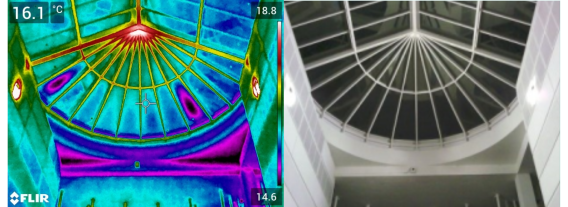
The Marlowes Shopping Centre: Turning Invisible Heat Loss Into a Clear Roadmap to EPC B
View Case Study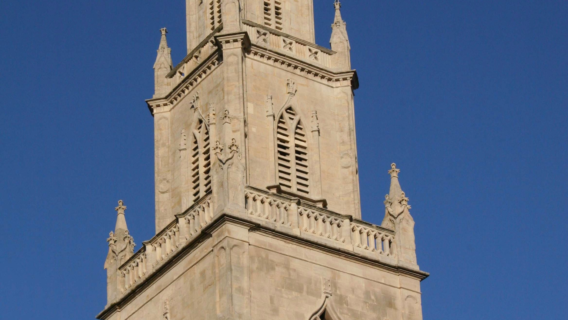
Churches Conservation Trust, St Paul’s Church: Right-Sizing a Heating Strategy Without Invasive Testing
View Case Study
St Werburghs City Farm: From Diagnostics to a Low Carbon Technology Strategy
View Case Study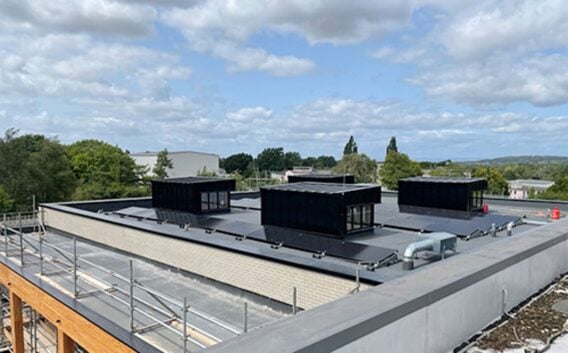
Bristol Veterinary School: Proving Fabric and Airtightness Performance for BREEAM
View Case StudyOct 28th, 2022

Thermographic Survey Requirements: Recommended Conditions
Read ArticleNov 19th, 2022

Thermographic Survey: What Is It?
Read ArticleJan 16th, 2025

Thermal Imaging: How It Works
Read ArticleApr 14th, 2025

WECA Green Business Grants: Green Community Building & Green Care Home Grants Explained
Read ArticleJul 23rd, 2026
The Bristol City Leap Community Energy Fund’s Sixth Round Is Open
Read ArticleAug 19th, 2026