
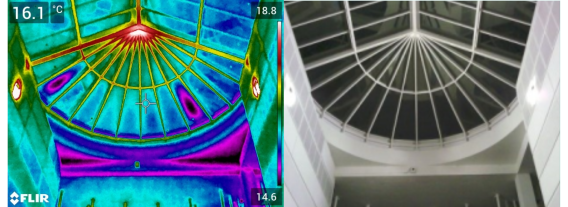
Temperature differences that are invisible to the naked eye can say a lot about how a building is actually performing. Thermal imaging makes those differences visible – using infrared cameras to capture and map heat rather than relying on a visual inspection alone. Its uses stretch well beyond domestic heat loss, into commercial fabric diagnostics, BREEAM assessment and quality-checking insulation after it’s installed.
In this blog, you’ll learn:
- What thermal imaging is and the technology behind it
- How an infrared camera actually captures and interprets heat
- Where thermal imaging gets used, from homes to live commercial buildings
- A real example of thermal imaging isolating a genuine defect from background noise
What is Thermal Imaging?
Thermal imaging, or infrared thermography, uses a specialised camera to capture infrared radiation and convert it into a visible heat map. Our Category 1 Thermographers use a FLIR E76 camera to carry out our assessments – the same equipment used across both domestic surveys and BREEAM-compliant commercial work.

The resulting image, known as a thermogram, reveals variations in surface temperature that point to specific problems: insulation gaps, air leakage, or moisture intrusion. It’s a non-invasive process: nothing about the building needs to be opened up or disturbed to get a reading.
Note: thermal imaging assessments of buildings are generally only carried out in autumn and winter, since a bigger temperature differential between inside and outside gives a clearer, more reliable result. Our Thermographic Survey Requirements guide sets out the specific conditions needed.
How Does Thermal Imaging Work?
An infrared camera detects the infrared radiation every object naturally emits and converts it into a visible heat map, with a colour scale representing temperature rather than light. That’s what makes a thermogram different from an ordinary photograph: it’s showing you temperature, not appearance
Three examples from our own surveys illustrate what this looks like in practice:

A flat’s ceiling reading noticeably cooler than its walls – a clear sign of missing ceiling insulation, not something visible to the eye alone.

Heat loss around a door – poor door seals causing air leakage, plus a distinct thermal bridge above the door frame itself.

A cold corner in a living room – flagging a condensation risk at that junction before any visible damp had developed.
Where Thermal Imaging Gets Used
Thermal imaging isn’t limited to a single-property home survey. The same technology underpins:
- Building heat-loss assessment – the most familiar use, whether it’s a single home or a large commercial building, covered in detail in our companion guide to thermographic surveys.
- BREEAM-compliant commercial surveys – when carried out to BRE 176 and BS EN 13187 it can support a building’s BREEAM thermographic credit.
- Diagnosing live, occupied buildings – picking out genuine fabric defects from a “noisy” environment (people, lighting, opening doors) rather than requiring an empty building to get a clean read.
- Quality assurance after installation – checking that insulation has actually been fitted properly and consistently, rather than assuming it has because it was specified.
Thermal Imaging in Practice: The Marlowes Shopping Centre
The Marlowes Shopping Centre needed a decarbonisation strategy to close the gap from an EPC C to a B – but first needed to know exactly where the building was losing heat. It’s a good example of thermal imaging being used well beyond a single home: a live, fully-trading retail centre with a complex glazed atrium, where cold sky radiation and other environmental variables had to be filtered out to get a genuinely reliable read rather than a list of false positives.
What’s Next?
Thermal imaging turns an invisible performance problem into something you can actually see and act on. That holds whether it’s a single home, a live retail centre with a glazed atrium or a building working toward a BREEAM credit – the same infrared technology, read by a trained thermographer, is what separates a genuine fabric defect from background noise.

If you’re weighing up whether thermal imaging is the right diagnostic for your property, get in touch and we’ll talk through what it could tell you.