

Commercial rented buildings are on a separate MEES 2031 trajectory – a year later than the domestic 2030 deadline – with their own thresholds, their own financial test, and their own set of exclusions entirely absent from the residential rules.
This guide covers what’s confirmed for commercial landlords specifically – domestic private and social landlords are on different timelines (see our guides to MEES 2030 for private landlords and MEES for social housing).
In this blog you’ll learn:
- The confirmed commercial targets, thresholds and payback test – and which buildings are exempt
- How the two-tier, size-based split at 1,000m² actually works
- Which lease structures fall outside MEES entirely
- Where an accurate EPC or air test can save unnecessary spend
Is Commercial MEES 2031 Confirmed, or Still a Proposal?
Not yet law. The commercial MEES 2031 EPC B threshold only takes effect once secondary legislation passes through Parliament – this is an interim response to the government’s non-domestic MEES consultations (updated 18 June 2026), not the final government response.
Two-Tier Model: Large vs Small Commercial Assets
Rather than a single EPC threshold across every commercial building, MEES for non-domestic buildings splits by size:
- Large commercial assets (over 1,000m²): Target EPC B by 2031 – “where cost effective.” That qualifier matters: the existing 7-year payback test and other exemptions remain in place, so only improvements that are practical, affordable and cost-effective will actually be required.
- Smaller assets (under 1,000m²): Remain pegged to the baseline EPC E standard. No new deadline has been introduced for smaller commercial premises yet – a deliberate choice to give SMEs and high street landlords more flexibility on timing.
- The previously proposed 2027 interim milestone (EPC C) has been dropped: landlords and tenants get more time to plan improvements around their own lease structures.
The government estimates this approach will save tenants in larger rented buildings up to £360 million a year in energy bills by 2031, while leaving smaller premises on a more flexible track.
The 7-Year Payback Test
Commercial MEES doesn’t work like the domestic cost cap. Instead of a flat spending limit, commercial landlords are assessed against a 7-Year Payback Test: a recommended improvement measure is only mandatory if the predicted energy bill savings over seven years equal or exceed the upfront cost of purchasing and installing it. If a measure doesn’t pay for itself within that window, it isn’t required.
Lease Structure Exclusions
Commercial MEES doesn’t apply universally across every commercial tenancy. It excludes:
- Short leases: granted for less than 6 months, unless the tenant has been in continuous occupation for over 12 months.
- Very long leases: of 99 years or more.
- True licences to occupy: properties occupied under a licence rather than a leasehold arrangement.
- Devaluation risk: an exemption also applies where the required works would reduce the property’s market value by more than 5%.
Penalties and Enforcement
Non-compliance penalties for commercial breaches are considerably higher than the domestic equivalent – up to £150,000 per breach, based on rateable value.
Scope Changes: Heritage Buildings
The blanket EPC exemption for listed buildings is being removed for commercial properties too, unless a specific “Negative Impact” exemption applies – where retrofitting would damage the building’s structural integrity or character. A low EPC score on a historic commercial building isn’t always a fabric problem, though – sometimes it’s the wrong assessment methodology, as we found when reassessing Walton Castle, a Grade II listed venue stuck on an outdated residential-basis EPC F that reached a compliant D once assessed correctly under the right commercial methodology, without any physical works.
Case Studies: Commercial MEES Compliance in Practice
Standard EPC software often defaults to harsh assumptions – estimated air leakage, outdated fuel metrics – when real building data isn’t supplied, which can understate a commercial property’s actual performance. An accurate commercial EPC assessment, backed by real air tightness testing data, is often the fastest, cheapest way to replace those defaults with a measured result rather than committing to physical works first.
Two Bristol warehouses show exactly this in practice – one held back by a failing default assumption, the other by a narrow miss on an A rating, both resolved with a single air test each:
For buildings already targeting the EPC B/2031 threshold specifically, precision thermal imaging can turn an assumed problem into a prioritised, costed schedule of interventions:
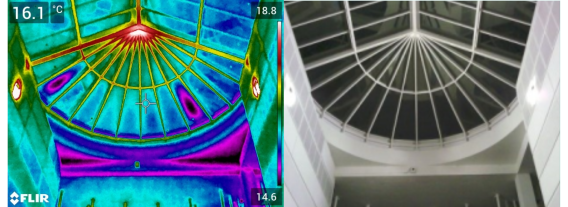
The Marlowes Shopping Centre: Turning Invisible Heat Loss Into a Clear Roadmap to EPC B
View Case StudyWhat’s Next? The countdown to MEES 2031…
With EPC B due by 2031 for larger assets and a 7-year payback test governing what’s actually required, waiting until the deadline approaches leaves less room to plan spend around lease events and budget cycles. An accurate, evidence-based assessment now is what makes that payback test work in your favour rather than against you.

We carry out Commercial Energy Surveys for commercial landlords and asset managers, modelling the payback periods that determine what’s actually required under the 7-Year Payback Test.