

Delivering the correct commercial methodology to unlock a Grade II listed venue’s true energy performance for MEES compliance.
Project Overview
- Client: Walton Castle
- Sector: Commercial & Industrial | Heritage & Listed Buildings
- Location: Clevedon, North Somerset
- Services Provided: Commercial Energy Performance Certificate (EPC)
- Scale: Grade II listed 17th-century 648 m² hunting lodge, exclusive-hire venue
- Target: MEES compliance – improved from F (30) to D (94)
The Challenge
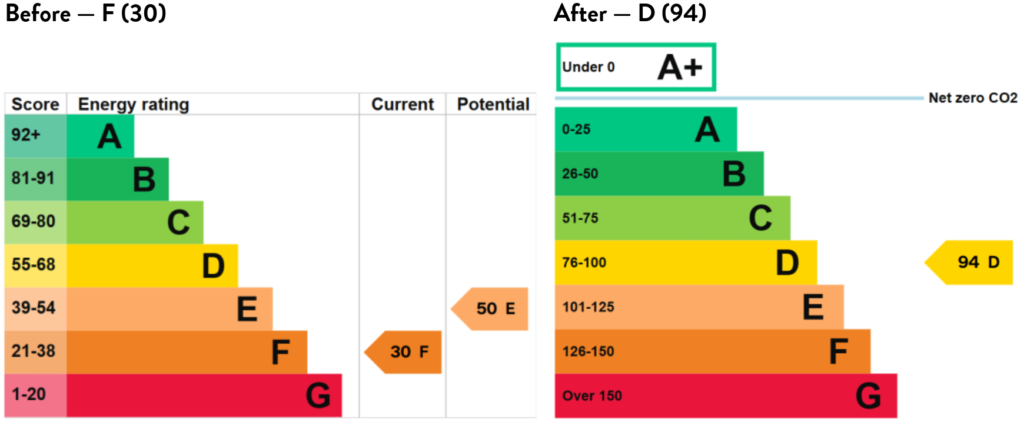
Walton Castle is a Grade II listed 17th-century hunting lodge, now operating as an exclusive-hire commercial venue – but its EPC hadn’t caught up with that change of use. The castle previously operated as a private residence, and its most recent assessment, from 2017, was a residential EPC that had never been updated to reflect its current commercial operation. That legacy assessment rated the property an F (30), a failing grade putting it at risk under Minimum Energy Efficiency Standards. The problem was methodological rather than physical: a residential EPC scores efficiency on fuel cost, and because the castle relies heavily on electricity, the software penalised it heavily for a fuel type that’s actually low-carbon under a commercial assessment. The previous report concluded that even after expensive renovation, the castle could only ever reach an E – leaving the owners facing a costly refurbishment programme to fix a rating problem that wasn’t really about the building’s fabric at all.
The Solution
Commercial EPC Reassessment
Our Lead Sustainability Consultant, Richard Millard, moved the assessment to a Commercial EPC methodology – changing the underlying metric from cost to carbon emissions. Because the UK electricity grid has decarbonised significantly since 2009, this single change unlocked several technical wins the residential assessment had missed. The Variable Refrigerant Flow (VRF) air conditioning system in the turret accommodation, previously penalised as “expensive to run,” was now correctly credited as low-carbon and highly efficient once modelled against detailed non-domestic HVAC profiles. The swimming pool’s heat pump – overlooked entirely in the previous report – was properly assessed, so its renewable energy contribution was finally credited to the building’s performance. We also corrected several fabric and systems details the 2017 survey had got wrong or defaulted on: one boiler was significantly newer than assumed, and the electric water heaters and fan heaters in the turrets no longer carried “default data” penalties once their actual specifications were used. Alongside this, we corrected the assessed floor area from 474 m² to a more accurate 648 m².
The Outcome
The results were transformative: the castle’s rating leapt from a failing F (30) to a strong D (94) – beating the maximum potential score the original residential assessment had predicted was achievable. Walton Castle is now fully MEES-compliant, accurately rated and marketable as the premium venue it is, without its owners having to spend a fortune on unnecessary physical renovation. It’s a clear demonstration that a low EPC score on a historic or unusual building isn’t always a fabric problem – sometimes it’s an assessment methodology problem.
Client Testimonial
I should like to say thank you so much to Rich and the team at Building Energy Experts for their efficiency and helpfulness in completing our commercial EPC survey in record time.
Assessing a historic property like Walton Castle requires real expertise, and your team delivered exactly that. Not only did they complete this survey with a very quick turnaround but they went above and beyond by providing extra information and guidance which has been extremely helpful.
We are delighted with the final result and once again thank you from both myself and the team at Walton Castle.
— Margarita Hamilton, Owner, Walton Castle
