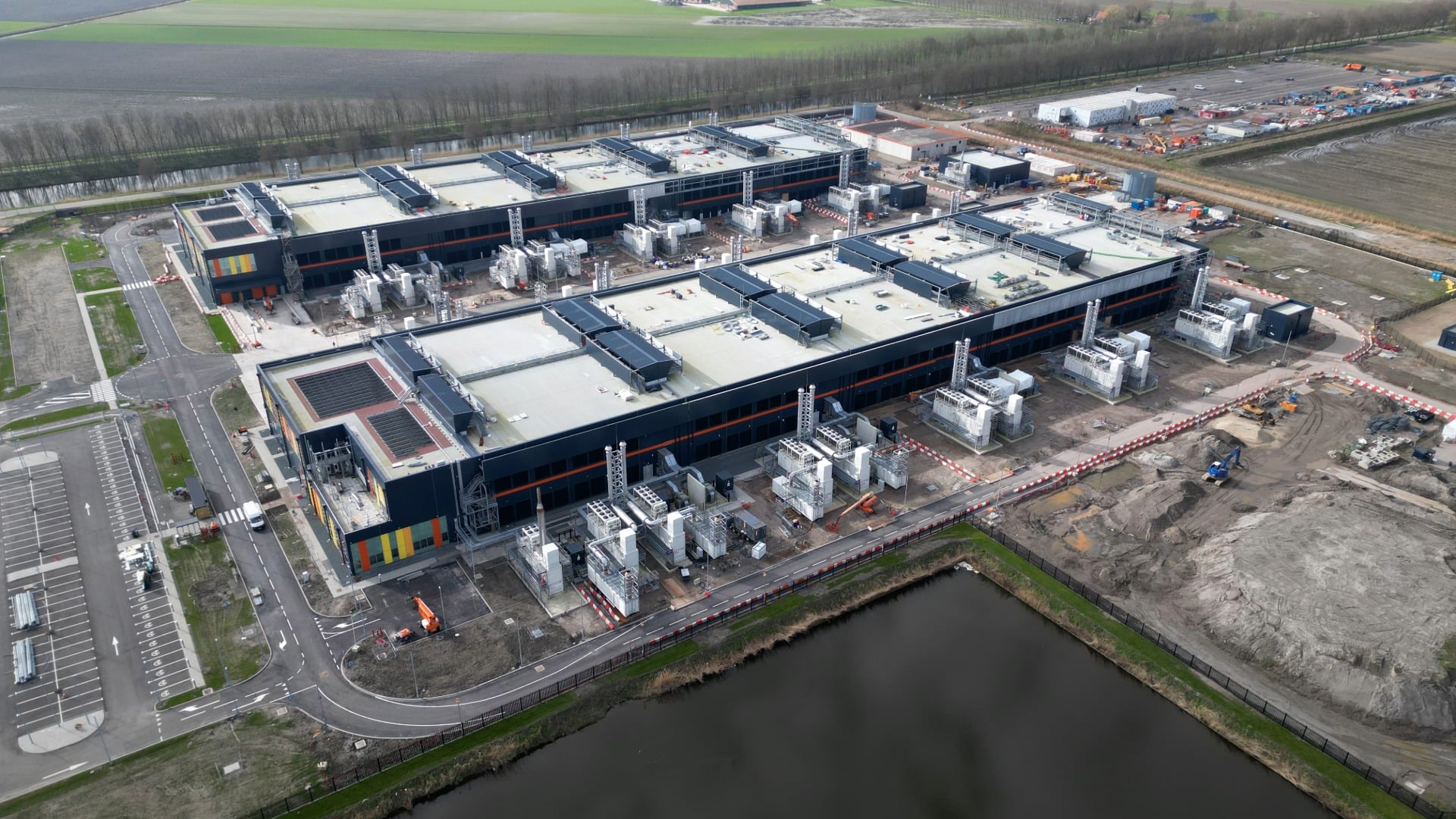
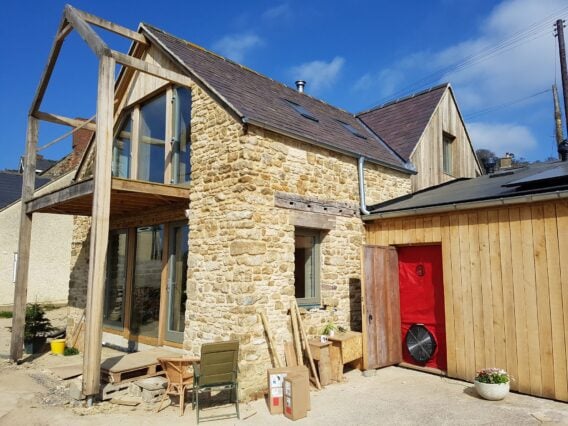
Delivering specialist air tightness testing calibrated for mission-critical environments – diagnosing fire suppression risk in a 20-year-old facility, and certifying Part L compliance on a live new-build campus.
Project Overview
- Client: Global data centre providers & construction partners (named clients withheld for confidentiality)
- Sector: Commercial & Industrial
- Location: UK (existing facility, UK; new-build campus, London)
- Services Provided: Air Tightness Testing (diagnostic and compliance)
- Scale: Ranges from a single legacy data hall to a multi-million-pound new-build campus
- Target: Part L compliance; air permeability benchmark of ~3 m³/h/m² @50Pa
The Challenge
For a data centre, air tightness isn’t primarily an energy question – it’s mission-critical. Gaseous fire suppression systems rely on a specific level of air retention to actually extinguish a fire, and uncontrolled leakage compromises cooling systems too, driving up energy costs and letting in dust and contaminants. That leaves operators and construction firms facing the same underlying question from two different directions: a 20-year-old facility needs to know how badly its seals have degraded, while a new-build campus needs certified proof of compliance before it can go live. Both required testing that could be trusted for genuinely critical decisions, carried out with the discretion these secure environments demand.
The Solution
Diagnostic Testing for an Ageing Facility
A global data centre provider commissioned us to assess a 20-year-old UK facility where years of wear were suspected to have compromised the data hall’s integrity. Our diagnostic test confirmed it: an air permeability rate of approximately 31 m³/h/m² @50Pa – more than ten times the accepted standard for a modern data centre. Using non-invasive methods, our engineers traced the leakage to specific paths, including degraded floor-to-wall seals, unsealed cable penetrations, and gaps at the building’s eaves. We compiled a detailed report with photographic evidence, giving the client a clear, cost-effective roadmap for targeted repairs rather than a blanket refurbishment.
Compliance Testing for a New-Build Campus
On a large-scale new-build data centre campus in London, we worked with a major construction partner to deliver mandatory compliance testing for building control sign-off. With multiple data halls completed in phases, testing had to fit tightly into an active construction schedule. We used multi-fan blower door air tightness testing to verify each data hall against Part L requirements as it was finished, giving both the construction partner and the end-user – a leading colocation provider – certified assurance to proceed with commissioning on time.
The Outcome
Whether diagnosing a live, ageing environment or certifying a new facility before handover, this work gave both clients the same thing: certainty. The ageing facility’s operator received a clear, prioritised repair roadmap that protects both fire suppression effectiveness and thermal efficiency without unnecessary spend. The new-build campus achieved phased Part L sign-off with no delay to the construction programme, giving the end-user confidence that a multi-million-pound facility was compliant, secure and efficient from day one. Across both, detailed reporting and clear pass/fail certification let data centre operators and their construction partners manage risk in one of the most safety-critical building types there is.
