
The shape of the Energy Performance Certificate is changing. On 21 January 2026, the government published its partial response to the consultation on “Reforms to the Energy Performance of Buildings” – updated 9 March 2026 to confirm the detail. The response locks in significant structural changes to how EPCs operate, with implementation targeted for October 2026.
This moves the domestic EPC regime away from a single headline rating towards a multi-metric approach, while tightening compliance requirements for previously exempt sectors.
In this blog you’ll learn:
- How domestic EPCs are moving from one headline rating to four separate metrics – and why non-domestic EPCs aren’t
- Which previously exempt property types (heritage buildings, HMOs, short-term lets) are now in scope
- What’s confirmed on EPC validity and marketing triggers, and what’s still genuinely undecided
Domestic EPCs: The Move to Four Metrics
Historically, domestic EPCs have relied on a single Energy Efficiency Rating (EER) based largely on fuel costs. This has often created a disconnect between a building’s thermal efficiency and its rating – for example, penalising electrically heated homes for higher unit costs relative to gas, regardless of how well-insulated they actually are.
That single rating is currently produced under RdSAP 10, the methodology used to assess existing homes since June 2025 – see our full breakdown of what changed when it launched.
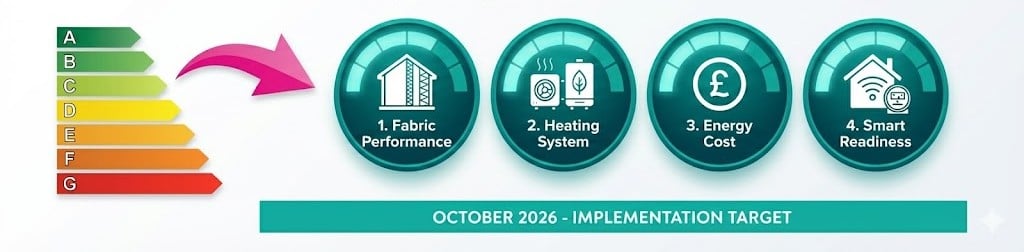
From October 2026, new-style domestic EPCs will display four separate headline metrics:
- Fabric Performance: A specific measure of the building envelope’s efficiency (walls, roof, windows and floors), independent of the heating system – separating the “insulation” assessment from the “technology” assessment.
- Heating System: A rating based on the efficiency and carbon intensity of the heat source.
- Energy Cost: An estimate of running costs, for transparency on affordability.
- Smart Readiness: A new metric assessing the building’s capacity to integrate with smart meters and flexible tariffs.
Transitional Arrangements: To maintain continuity for the “EPC C by 2030” target, the legacy EER metric will be retained temporarily alongside the new metrics, and a secondary carbon-based metric is also being kept for a modelled-emissions snapshot.
These four metrics will be calculated using the Home Energy Model – the same underlying transition covered in our guide to the shift from SAP to HEM, which goes into more depth on the calculation method itself and the data it now requires.
Non-Domestic EPCs: Retaining the Carbon Standard
For commercial and non-domestic buildings, the government has opted to maintain the status quo on the headline metric. Non-domestic EPCs will continue to use the Carbon-based Environmental Impact Rating (EIR) as the single headline rating – the consultation response confirms this remains the most effective tool for businesses reporting on Net Zero progress and managing non-domestic MEES compliance.
A Grade II listed venue reassessed under the correct commercial EPC methodology, without any physical works:
Regulatory Scope: Exemptions Removed
The response confirms the requirement for a valid EPC is extending to several sectors previously exempt or sitting in regulatory grey areas:
- Heritage & listed buildings: The exemption is being removed. Landlords of listed buildings will need a valid EPC when the property is marketed, sold or let.
- HMOs (Houses in Multiple Occupation): A valid EPC for the whole building will be required whenever a single room is rented out – with a 24-month transitional period for HMO landlords to obtain one and reach MEES compliance.
- Short-term & holiday lets: A valid EPC will be required regardless of whether the guest is responsible for paying the energy bills.
This aligns with the wider tightening of the Minimum Energy Efficiency Standards (MEES):

Timelines and Validity
Validity period: The government consulted on cutting EPC validity from 10 years to 5, to improve data accuracy. Following industry feedback on cost, it’s confirmed EPCs will keep their 10-year validity period – both existing and reformed EPCs.
Marketing trigger point: Current rules allow up to 28 days after a property is first marketed for a valid EPC to be obtained. That flexibility is being removed – a valid EPC will be required at the point of marketing itself, not within a grace period afterwards.
Still undecided: Whether a new EPC will be required every time an existing one expires during a tenancy – rather than only at the point a new tenancy begins – is not yet confirmed. The government says it’s “working to refine the position” to make sure this interacts properly with the wider MEES regulations, with detail to follow in the final response.
Implementation date:
- This partial response (21 Jan, updated 9 March 2026) covers what EPCs measure and when they’re required.
- A further response – covering DEC validity, EPC and DEC data, EPC quality, and Air Conditioning Inspection Reports – is expected later in 2026, alongside the final response to this consultation.
- October 2026 remains the target launch date for new-style domestic EPCs.
Source: MHCLG/DESNZ, Reforms to the Energy Performance of Buildings regime: partial government response, published 21 January 2026, updated 9 March 2026.
Industry Implication: The Focus on Fabric
The introduction of a standalone Fabric Performance metric is a significant shift. By decoupling fabric efficiency from heating costs, the new regime is likely to expose properties that rely on low-carbon heating systems to mask poor insulation – a low-carbon heat pump can no longer paper over a draughty building on the certificate itself.
For asset managers and landlords, this reinforces the case for a fabric-first retrofit strategy: upgrades to insulation and glazing will be directly visible on the certificate, rather than buried within a composite score.
What’s Next?
With EPC reform set for October 2026, the properties most exposed are the ones that look fine under the current single rating but would score poorly on Fabric Performance alone – typically electrically heated homes with good cost scores but weak insulation. Reviewing where those properties sit now, before the new metrics go live, is the cheapest point to catch it.

Get in touch with our technical team to review your portfolio against the new Fabric Performance metric ahead of the October 2026 rollout.