

The Optimised Retrofit Programme (ORP) is the Welsh Government’s flagship initiative to decarbonise the nation’s social housing stock. Moving away from “blanket” single-measure approaches, ORP takes a data-driven, home-by-home strategy to find the most cost-effective and logical pathway to net zero for each property.
Whether you’re planning your next round of funding or trying to de-risk your installation pipeline, this guide covers how the ORP framework actually operates, how the key legal standards overlap, how ORP funding is allocated, and how social landlords bridge the gap between theoretical energy models and real-world performance.
In this blog you’ll learn:
- Why ORP mandates complex, multi-measure, fabric-first strategies over quick single-measure fixes
- How PAS 2035, WHQS 2023 and Awaab’s Law overlap – and why a compliance lodgement isn’t the same thing as a long-term strategy
- The mandatory TEP coverage milestones social landlords are facing this delivery year
- How ORP funding is allocated, and where to find the official application guidance
- The repeatable annual delivery cycle that sits behind every ORP funding round, regardless of the specific dates in play that year
What is the Optimised Retrofit Programme?
The Optimised Retrofit Programme (ORP) is a whole-house, pragmatic approach to decarbonising existing homes, open to Registered Social Landlords (RSLs) and local authorities across Wales. Rather than treating insulation, heating and energy supply as separate problems, it assesses each property as one system – the fabric it’s built from, how it’s heated and stores energy, and how energy actually reaches the home – to find the specific route to net zero that fits.
The programme takes a “test and learn” approach, with a risk appetite that matches the innovative, entrepreneurial activity decarbonisation at this scale actually requires. It’s also intended to do more than fix individual homes: ORP is designed to support the wider infrastructure needed for retrofit at scale – skills development, procurement, finance models and material selection – and underpins the Welsh Government’s ongoing retrofit policy across all housing sectors, drawing on the principles set out in the Better Homes, Better Wales, Better World report.
Since its inception in 2020, the programme has invested hundreds of millions of pounds, transforming tens of thousands of homes across Wales through continuous, multi-year government funding rounds. The current phase is ORP3 Year 5 (ORP3.5), covering financial years 2026 to 2027, with £98.75 million in live grant funding available across Welsh social housing this round. It continues to centre on two themes: affordable warmth and decarbonisation, alongside identifying the best pathway to better energy efficiency for each home and its residents. It’s also intended to support the Welsh Housing Quality Standard 2023 as it’s established as the new benchmark.
ORP Funding: How Is It Allocated?
ORP funding runs through continuous, multi-year Welsh Government rounds rather than a single application window, and it’s open to Registered Social Landlords and local authorities delivering whole-house retrofit rather than isolated single measures. Allocation follows the annual delivery cycle below – new grant rounds open at the start of each cycle (Q1), with property selection driven by stock-wide Target Energy Pathway data rather than a first-come-first-served application process.
Specific eligibility, funding caps and the current ORP 3 application window are set out directly in the Welsh Government’s own ORP guidance – we work alongside RSLs and local authorities to build the archetyping and modelling evidence base that a strong funding application needs, but the application itself goes through the Welsh Government directly.
How ORP Differs From Traditional Grant Schemes
Traditional grant schemes often incentivise single, isolated measures – installing solar PV or a heat pump without addressing the building’s thermal envelope. ORP rejects that approach in favour of:
- Fabric-first principles: insulation, draught-proofing and ventilation are prioritised to reduce energy demand before complex renewable heating systems go in.
- Pragmatic sequencing: upgrades are applied incrementally, based on what makes sense for the specific property type and tenant context.
- Local economic value: funding criteria explicitly favour local supply chain development, job creation and upskilling within Welsh communities.
- Mandatory environmental monitoring: performance data is collected post-installation to verify that predicted energy savings match real-world outcomes.
The Compliance Framework: PAS 2035, WHQS 2023 & Awaab’s Law
For Welsh social landlords, a compliant retrofit means managing two distinct roadmaps in tandem: a strategic goal (the Target Energy Pathway, under WHQS 2023) setting out where each property needs to end up, and an operational standard (PAS 2035:2023) translating that goal into a safely sequenced physical roadmap.
1. The Target Energy Pathway (TEP) – The Strategic Goal
Mandated under WHQS 2023, the TEP is a whole-stock modelling exercise. It establishes a property-specific route to achieving a low-carbon heating system and optimal energy performance by 2034.
This delivery year carries two mandatory intermediate TEP coverage milestones: social landlords must demonstrate 75% TEP stock coverage by 1 September 2026, and 100% coverage by 31 March 2027. These milestones are why portfolio archetyping and baseline data collection are urgent priorities right now, not a distant 2034 concern.
Strategic goal: the TEP is the destination, not a single grant-funded package – it’s what keeps the housing stock compliant with WHQS long-term. Surveying every property individually to build a TEP isn’t always realistic at portfolio scale – archetyping is often the more defensible route.
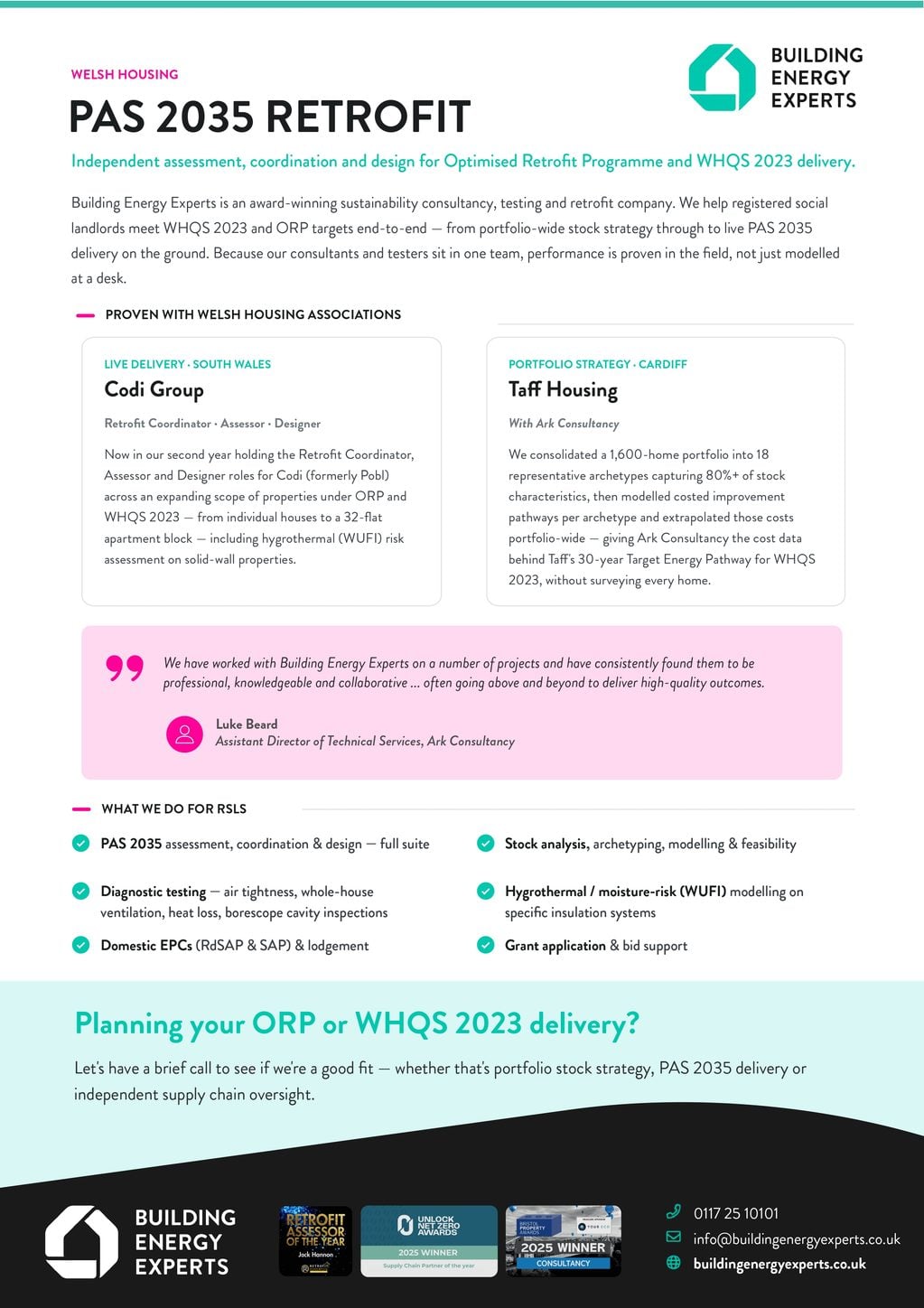
We delivered portfolio-wide PAS 2035 archetyping and costed improvement modelling for Taff Housing, underpinning a 30-year Target Energy Pathway for 1,600 properties:
2. The Medium Term Improvement Plan (MTIP) – The Rulebook
Required under the updated PAS 2035:2023 framework, the MTIP is a 20-to-30-year operational roadRequired under the updated PAS 2035:2023 framework, the MTIP is a 20-to-30-year operational roadmap. It translates the strategic TEP goals into safely sequenced physical stages, which are officially logged via TrustMark.
- Awaab’s Law & moisture integration: expert damp, mould and ventilation diagnostics are mandatory under PAS 2035. Ventilation must be designed and installed before or alongside airtightness measures, to prevent trapped moisture and protect tenant health.
- Operational goal: provides the documentation needed for TrustMark lodgement and grant drawdown.
Key takeaway: don’t confuse a lodgement with a long-term strategy. An MTIP clears the bar for immediate funding and safe sequencing; the Target Energy Pathway is the strategic goal it’s working towards, keeping your stock legally compliant through to 2034.
3. Supply Chain Certification: PAS 2030 & PAS 2035:2023
The transition period for PAS 2019 standards has now formally ended. Full PAS 2035:2023 compliance for design and coordination, and PAS 2030:2023 for installer certification, are strictly mandatory for any contractor delivering ORP-funded works – there’s no legacy PAS 2019 accreditation route left. This directly affects which installers a landlord’s supply chain can legally use, so it’s worth checking now rather than at the point of TrustMark lodgement.
Case Study: Scaled Delivery with Codi Group
We are in our second year as retrofit consultants for Codi Group – formerly Pobl Group, and the largest social landlord in Wales – who appointed us to hold the Retrofit Coordinator, Assessor and Designer roles across their portfolio: a scope that’s expanded property by property as the framework has rolled out, from individual houses scattered across separate Newport streets to Sunnyhill, a 32-flat block in Llanelli.
That range is the point. A 32-flat block needs a different delivery rhythm to a handful of scattered houses, and treating each property type on its own terms – rather than forcing one process onto both – is what the framework is built to do. All of it is working towards WHQS 2023’s own bar: SAP 75 by 2030, SAP 92/EIR 92 by 2034.
The Standard Annual Lifecycle of ORP Delivery
Specific application dates shift between financial cycles, but successful ORP delivery follows a repeatable annual workflow. For the current 2026–2027 delivery year, that workflow carries these concrete campaign dates:
- Q1 (Spring) – Cycle launch & grant allocation: new ORP grant rounds are allocated; property selection begins, based on stock-wide TEP data.
- Q2 (Summer) – Assessment & moisture design: BS 40104 retrofit assessments, airtightness testing and PAS 2035 Retrofit Designs (prioritising ventilation). 1 September 2026: interim WHQS Part 3 progress check – the 75% TEP milestone.
- Q3 (Autumn) – Procurement & installation: multi-measure installation on site; contractor compliance monitored against PAS 2035 standards. November 2026: mandatory Welsh Government ORP mid-term progress review.
- Q4 (Winter) – Lodgement & verification: environmental sensor deployment, TrustMark Data Warehouse lodgements and annual compliance reporting to Welsh Government. 31 March 2027: hard delivery deadline for 100% TEP stock coverage and TrustMark lodgement of all ORP3.5-funded works.
What’s Next?
Whichever stage of the annual cycle your landlord is at, the same principle holds: a PAS 2035 lodgement gets you through the funding door, but only a properly mapped Target Energy Pathway keeps your stock compliant through to 2034. We provide the evidence base behind both – independent Retrofit Coordination, moisture-safe Retrofit Design, and portfolio archetyping and modelling to underpin your Target Energy Pathway – as the bridge between securing funding and delivering it safely on the ground.

We carry out Retrofit Assessment, Coordination and Design for social landlords and local authorities delivering under the Optimised Retrofit Programme.