
An SBEM report is the paperwork proof of compliance – the BRUKL Report Building Control actually reads, and the document your As-Built Commercial EPC is generated from. Knowing what’s inside it, and what a pass or fail actually means, is the difference between catching a problem early and finding out only when a submission bounces back.
In this blog you’ll learn:
- What a BRUKL Report actually contains
- The difference between TER and BER, and what “passing” means
- How Design Stage and As-Built reports differ
- How the report becomes your Commercial EPC
- What “SBEM certificate” usually actually refers to
What is an SBEM Report? The BRUKL Explained
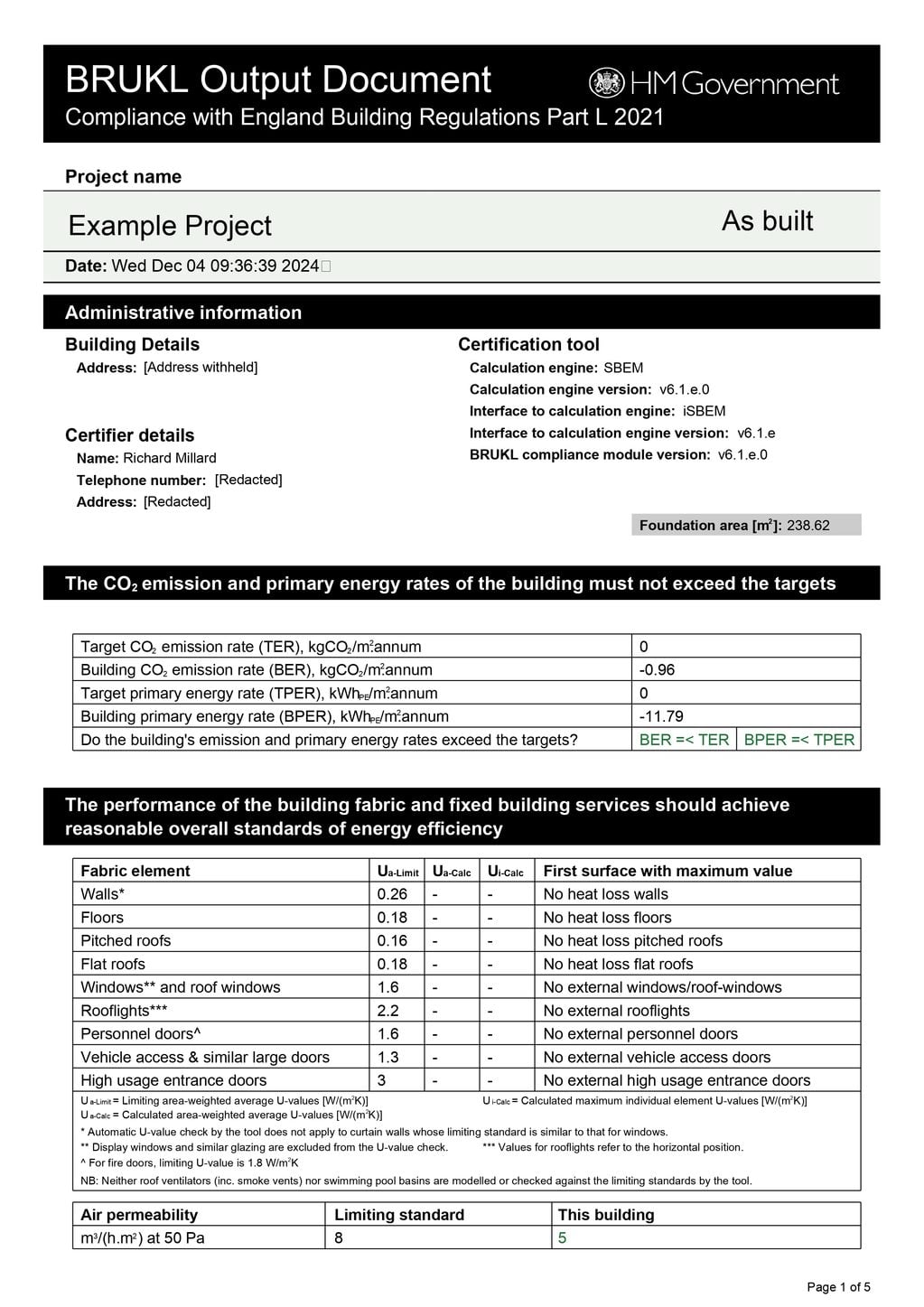
BRUKL stands for Building Regulations UK Part L – it’s the standard output format for an SBEM calculation, and the document that actually gets submitted to Building Control. A BRUKL Report sets out the building’s fabric specification (U-values for walls, floors, roof and glazing), its HVAC and lighting systems, and a direct comparison between the building’s calculated emissions and the target it needs to beat. For how that data gets collected in the first place, see our SBEM Assessment guide.
Reading Your SBEM Report: TER vs BER and What “Passing” Means
Every BRUKL Report centres on two figures. The Target Emission Rate (TER) is the benchmark your building has to beat – based on a theoretical “Notional Building” of the same size and shape, built to minimum-compliant specification. The Building Emission Rate (BER) is what your actual design achieves once its real fabric, systems and geometry are modelled. To pass, the BER has to be equal to or lower than the TER. The margin between the two – not just a straight pass or fail – is what tells you how much headroom a design has, and how much risk there is if something changes during construction.
Design Stage vs As-Built SBEM Reports: What Changes
A Design Stage BRUKL Report is generated from drawings and specifications before construction starts, proving that the building will comply if it’s built as designed. An As-Built BRUKL Report is generated after completion, using the building as it was actually constructed – which is why details like air permeability test results matter so much at this stage: without one, the software defaults to a punitive assumption that can turn a design-stage pass into an as-built fail.
From BRUKL Report to Commercial EPC
The As-Built BRUKL Report is the basis the Commercial EPC gets generated from. Where the BRUKL Report is the technical evidence Building Control needs, the Commercial EPC is the public-facing certificate – graded A+ to G – that’s legally required to sell, let or lease a commercial property.
“SBEM Certificate”: What People Usually Mean
There’s no single document called an “SBEM certificate” – SBEM is a calculation methodology, not a certificate. When someone asks for one, they’re almost always after either the BRUKL Report (the technical proof of compliance) or the Commercial EPC (the certificate that’s actually displayed and legally required for a sale or letting).
What’s Next?
Whether you’re reviewing a Design Stage SBEM report ahead of construction or trying to understand why an As-Built submission came back with issues, knowing what the report is actually measuring makes it far easier to act on.
We carry out SBEM calculations and issue BRUKL Reports and Commercial EPCs at both Design Stage and As-Built for projects across the South West and nationwide.