
With climate change and population growth placing continuous pressure on the UK’s water resources, building sustainable, water-efficient homes is a permanent priority across the construction sector. With forecasts projecting a long-term public water supply deficit of billions of litres per day, regulatory bodies and water companies rely on financial mechanisms to drive water efficiency in new developments.
For developers, understanding how to leverage these incentives is a critical strategy for reducing infrastructure charges, cutting site development costs and boosting overall SAP scores.
In this blog you’ll learn:
- What the Environmental Incentives Common Framework actually requires of water companies, and how it’s funded
- The Part G efficiency checklist you need to specify against to qualify for incentive payments
- Why the water calculation directly affects your SAP score and EPC rating
- How the incentive tiers and audit process work, and where the burden of proof sits
What Is the Environmental Incentives Common Framework?
Published by Ofwat, the Environmental Incentives Common Framework shifted the industry from voluntary, site-by-site reviews to a structured, mandatory incentive system across England.
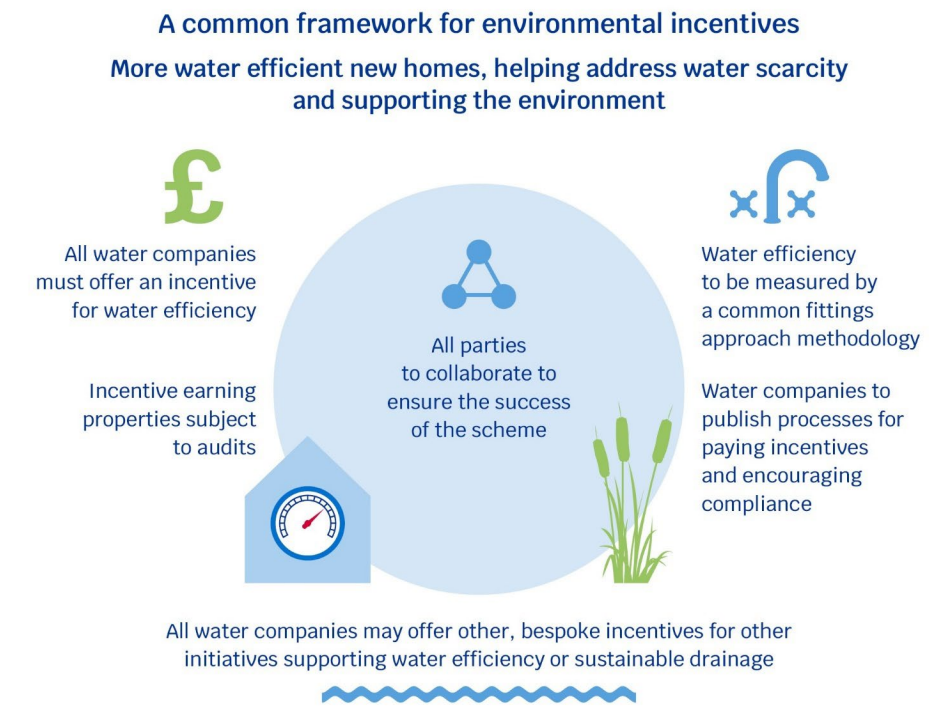
Under this framework:
- Mandatory offers: All English water companies must offer water efficiency incentive payments to developers who build homes consuming significantly less water than the baseline requirements of Part G Building Regulations.
- Ring-fenced funding: Incentives are funded by a dedicated “environmental component” within infrastructure charges, ensuring these funds are used exclusively for sustainable developments.
- Level playing field: New Appointees and Variants (NAVs) are mandated to match the environmental incentives and qualifying criteria of the incumbent local water company, so the rules stay consistent regardless of who supplies a given site.
Designing to these efficiency targets keeps sites compliant and resilient as building regulations and local water neutrality requirements continue to tighten over time.
Meeting the Targets: Efficiency Checklist for Part G
To qualify for standard financial incentives, specifications generally need to go beyond the baseline Part G requirement of 125 litres per person per day (l/p/d) – the statutory target that applies to new dwellings created by new construction – or the standard 110 l/p/d optional requirement some local authorities apply. The framework’s Common Environmental Incentive Methodology sets specific maximum flow rates and consumption limits per fitting:
- Showers: Reduced flow rates, typically 7 L/min or below.
- Taps (basins & kitchen): Aerated or restricted-flow fittings.
- WCs: Dual-flush systems with reduced flush volumes.
- Baths: Fixed maximum capacity limits.
- Water reuse: Rainwater harvesting or greywater recycling integrated into the design.
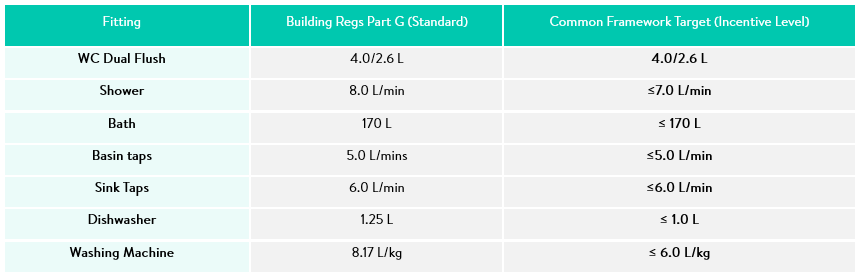
Exact maximum thresholds are defined in Ofwat’s Common Environmental Incentive Methodology guidelines – check the current version before finalising a specification against these targets.
Worth designing with headroom, too. DEFRA has proposed lowering the statutory baseline itself, from 125 to 105 l/p/d, with the optional target cut from 110 to 100 – part of a wider push to ease water scarcity and unblock stalled housing developments in constrained areas. This is a consultation proposal rather than a change already in force, but if it lands, both the qualifying baseline above and the incentive tiers below would shift with it.
Why Water Efficiency Matters for SAP Scores and Budgets
There’s a direct link between internal water efficiency and overall building energy performance.
1. Regulatory Alignment & SAP/EPC Scores
Complying with Part G is mandatory for new dwellings, but targeting higher incentive tiers creates a genuine double benefit: the Part G water calculation directly feeds into SAP calculations and the final EPC rating. Because heating domestic water accounts for a substantial share of a home’s energy demand, specifying lower flow rates – 7 L/min showers, for example – meaningfully reduces energy load. Overlooking flow rates can mean an unexpected, avoidable hit to the final energy rating.
This link runs deeper under the Home Energy Model, too – HEM introduces far more granular hot water data requirements than SAP ever did, covering flow rates for basin and kitchen taps as well as showers, plus bath volumes in litres. Our guide to the SAP-to-HEM transition covers this in more depth for anyone specifying fittings with an eye on both Part G and the incoming compliance tool.
2. Direct Infrastructure Savings
Incentives act as a direct offset against developer infrastructure charges, typically structured across distinct tiers:
- Tier 1 (high efficiency): Cash-back or charge reductions per plot for hitting low daily consumption targets – commonly somewhere under 110 l/p/d, with a further step up under 85 l/p/d.
- Tier 2 / water neutrality: Larger payments per plot for implementing advanced greywater recycling, rainwater harvesting, or full water neutrality systems.
Charging periods: Water companies publish updated Developer Services Charging Schemes annually, effective 1 April each year. Always consult your specific water undertaker’s latest charging schedule at the design stage to confirm current payment rates per plot – rather than relying on a fixed figure quoted elsewhere, since these are revised every year.
If the proposed baseline cut to 105/100 l/p/d goes ahead, these tier thresholds are the part most likely to move – a consumption figure that qualifies for Tier 1 today could shift closer to the new standard baseline rather than counting as high efficiency. Worth checking the current DEFRA consultation status and your water undertaker’s latest charging schedule before treating today’s tier thresholds as fixed for a multi-year development programme.
Ensuring Compliance: Audit Procedures
The framework enforces a standardised auditing process to ensure the promised efficiency levels are actually delivered on site:
- Timing: Audits take place on completed premises, with all specified fittings fully installed, but prior to occupancy.
- Burden of proof: The applicant or developer is responsible for providing water calculation sheets, fitting specification schedules, and proof of installation.
- Consequences of non-compliance: If audited fittings don’t match the submitted calculations, water companies can recover costs, reclaim incentives already paid, or reject future applications.
What’s Next?
Designing toward “water smart” communities is a clear route to lower infrastructure costs alongside meeting tightening regulatory standards – but only if the specification is right from the start. Retrofitting a scheme to hit a lower consumption tier after fittings are already specified is far more expensive than designing for it from the outset, and the SAP benefit only lands if the water calculation is correct the first time.

We carry out Part G water calculations and flow-rate optimisation for developers targeting these incentive tiers, working from your actual fitting specifications to protect both the qualification and the SAP benefit.