
On 28th January 2026, the government published its policy statement confirming the first revision of the Decent Homes Standard in 20 years – locking in the deadlines, energy metrics and specific criteria landlords must now meet to comply with the new Decent Homes Standard by 2035.
In this blog you’ll learn:
- What the new Decent Homes Standard’s five new criteria actually require – including the HHSRS hazard categories and facility thresholds behind them
- What the 2030 and 2035 deadlines mean for social and private landlords
- How Criterion D ties the Decent Homes Standard to MEES – and where to find the full fabric, smart and heating metric breakdown
- Where funding and support is available to help meet these deadlines
What is the New Decent Homes Standard?
First introduced in the early 2000s, the Decent Homes Standard is the technical benchmark used to ensure that social housing meets a minimum level of quality. The 2026 update modernises these rules and confirms that, from 2035, they will apply to the Private Rented Sector as well as Social Housing.
New Decent Homes Standard Criteria
Under the new policy statement, a home is only considered “decent” if it meets 5 specific criteria:
- Criterion A (Hazards): Free from Category 1 Hazards under the Housing Health and Safety Rating System (HHSRS) – originally organised around 29 hazard categories, now consolidated into 21 under updated statutory guidance, spanning health risks (damp, excess cold, carbon monoxide), physical safety (falls, fire, electrical faults, structural collapse), security and space, and sanitation. A hazard scoring 1,000 or more counts as Category 1 – triggering mandatory council intervention and an automatic Decent Homes fail.
- Criterion B (Repair): In a reasonable state of repair – assessed on condition rather than age. A property fails if a single key component (or two or more non-key components) is in disrepair; key components explicitly include mechanical ventilation systems, lifts, heating boilers, roofs, structural walls and windows.
- Criterion C (Facilities): Must provide modern facilities and child-resistant window restrictors on windows with a genuine fall risk (a floor-to-outside drop over 600mm and an opening over 100mm). The facilities requirement itself is about presence and adequacy, not age, and differs by property type: flats must meet at least 3 of 4 core facilities (kitchen, bathroom/WC, noise insulation, common entrance layout), houses at least 2 of 3 (kitchen, bathroom/WC, noise insulation).
- Criterion D (Thermal Comfort): Must provide a reasonable degree of thermal comfort and meet Minimum Energy Efficiency Standards (MEES) – EPC C by 2030.
- Criterion E (Damp & Mould): A new standalone criterion, with a materially lower tolerance than the old hazard-only approach – under HHSRS’s damp and mould scoring bands (A to J), anything assessed in Bands A to H now fails this criterion on its own, with only minimal or traced issues (Bands I and J) excluded. That forces intervention well before a property reaches a severe Category 1 hazard (Bands A-C) or triggers enforcement under Awaab’s Law.
We’re driving up the quality of social housing so they’re well insulated and damp-free to keep families safe and cut their energy bills.
— Steve Reed, Housing Secretary
New Decent Homes Standard: How the Rules Apply, Tenure by Tenure
While the ultimate goal is a unified standard by 2035, the immediate obligations differ by tenure.
For Private Landlords
- The New Decent Homes Standard (2035): The government has confirmed a “nine-year implementation period,” meaning full enforcement of the new Decent Homes Standard for the private rental sector will start in 2035.
- The Energy Exception (MEES 2030): The 2030 Energy Efficiency deadline is not delayed by this – private landlords must hit EPC C by 1 October 2030 regardless of the wider 2035 timeline, under MEES’s own fabric-first rule and £10,000 cost cap. See our full MEES 2030 guide for private landlords.
- Funding Support: The Boiler Upgrade Scheme (£7,500 towards a heat pump) and low-interest “Warm Homes” loans can help offset the £10,000 cost cap – see our full guide to energy efficiency grants and loans, alongside the Warm Homes: Local Grant as a further route worth checking eligibility for.
- Awaab’s Law – watch this space: As of the January 2026 policy statement, the government intended to consult on extending this to private rentals too.
From 2035, private landlords must meet the same quality benchmarks as social housing providers. Local authorities will have the power to inspect private properties and issue enforcement notices or fines if they fail to meet decency levels.
For Social Housing Landlords
- The New Decent Homes Standard (2035): Social landlords already meet the current Decent Homes Standard, but the reformed 5-criteria version confirmed in this policy statement becomes mandatory from 2035, the same date private landlords face full enforcement.
- Awaab’s Law – already in force: Social landlords have had to investigate reports of damp and mould within 10 working days and begin significant repairs within 5 working days if the hazard poses a risk to health since October 2025. Emergency hazards must be addressed within 24 hours.
- Criterion D Deadline 1 (MEES): EPC C (meeting any one metric) by 1 April 2030.
- Criterion D Deadline 2 (MEES): Compliance with two metrics by 1 April 2039 – social landlords can choose which metric (Fabric, Smart or Heating) to prioritise at each stage, based on their stock type. See our full guide to MEES for social housing for how that choice plays out in practice.
- Funding Support: Rent convergence returns from April 2027 – CPI+1% plus £1/week, ring-fenced for energy upgrades – alongside the Warm Homes: Social Housing Fund as the primary route for retrofit capital.
Until 2035, social homes must continue to meet the current Decent Homes Standard while preparing for the stricter new criteria.
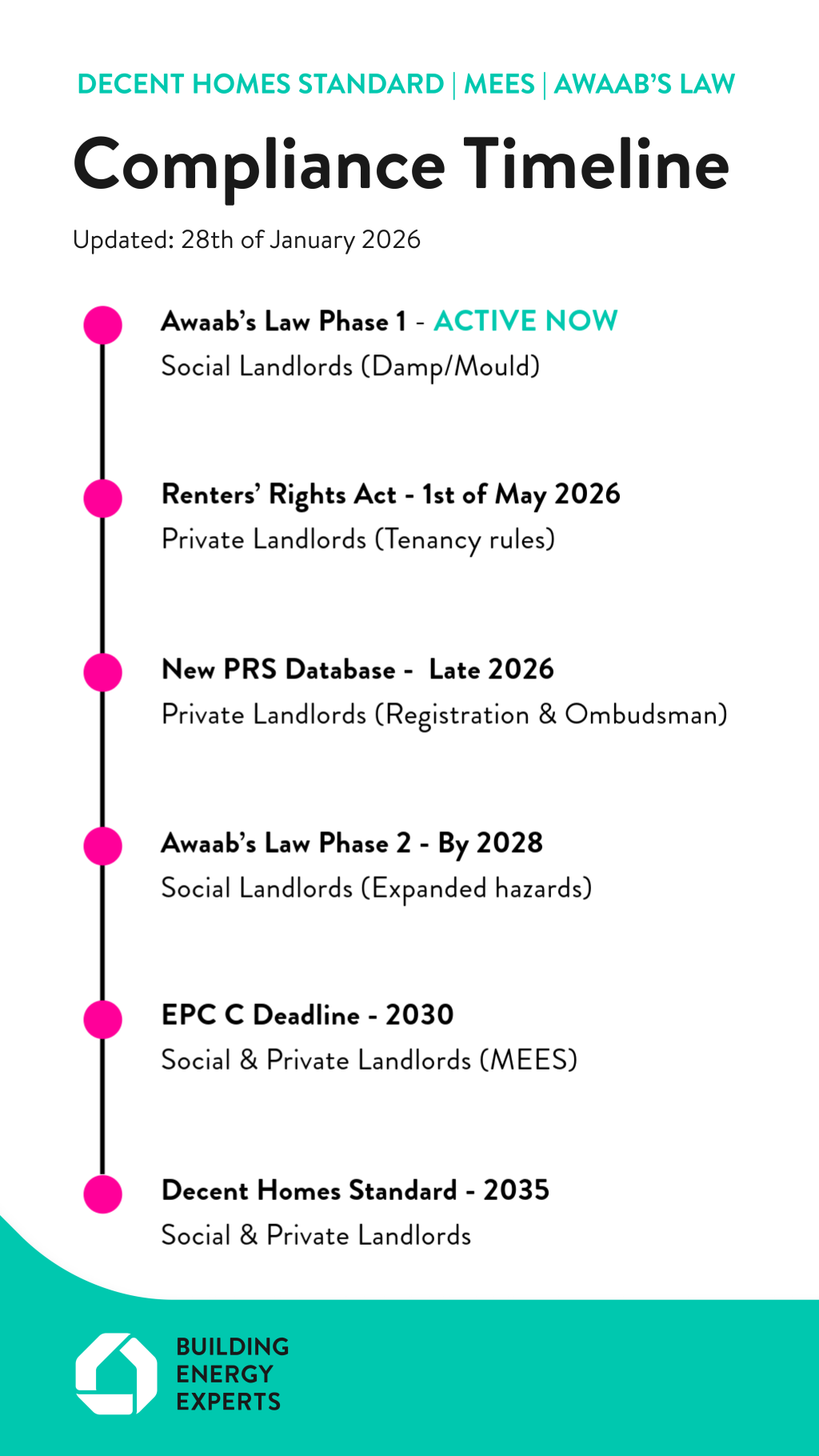
Implementation Timeline for Upcoming Regulations
Case Study: Building the Evidence Base
North Warwickshire Borough Council needed a defensible, up-to-date EPC and retrofit evidence base to plan its compliance against both Minimum Energy Efficiency Standards and the new Decent Homes Standard – not the ageing dataset it had, where a third of certificates were over a decade old and a meaningful share had no record at all.
We’re running two parallel streams: a large-scale EPC programme closing those gaps across the whole stock, and an archetype-led programme – PAS 2035 retrofit assessments and full Optioneering across 50 representative archetypes – building a costed, evidenced improvement pathway for each.
What’s Next?
The complexity of the new “Fabric First” rule for private landlords and “Metric Flexibility” for social landlords means that a generic retrofit strategy won’t work. What every portfolio needs instead is its own evidence base – accurate, up-to-date EPCs, defensible archetyping and a costed pathway to the 2030 and 2035 deadlines – rather than a single measure applied uniformly across very different stock. That starts with knowing exactly where your portfolio stands today, not assuming an ageing dataset still reflects reality.
We carry out Decarbonisation Feasibility Studies for housing associations, local authorities and private landlords – including a focused MEES Compliance Report mapping the fastest, most cost-effective route to EPC C ahead of the 2030 and 2035 deadlines.