
Part L of the Building Regulations sets the minimum energy performance standard for new dwellings – and the version currently in force, the 2021 uplift, has been the baseline since June 2022. For anyone still working from pre-2022 assumptions, or unsure whether Part L 2021 or the Future Homes Standard applies to their project right now, getting this straight matters: the wrong assumption here affects fabric specification, air tightness targets, and SAP evidence requirements from day one of design.
In this blog you’ll learn:
- What Part L 2021 actually requires now, including air tightness, U-values and fabric standards
- Why sample air tightness testing is no longer permitted and what replaced it
- How SAP has moved on since this regulation came in and where SAP 10.3 fits today
- When Part L 2021 stops being the baseline, and the Future Homes Standard takes over
What Is Part L, and What’s Current Right Now?
Part L 2021 came into force in June 2022, requiring a 31% reduction in CO2 emissions compared with the previous Part L 2013 standard. It applies on an individual-dwelling basis rather than site-wide – a building notice submitted before June 2022, with work commencing before June 2023, could still be built to the older 2013 standard; anything registered or commenced after that had to meet the 2021 uplift.
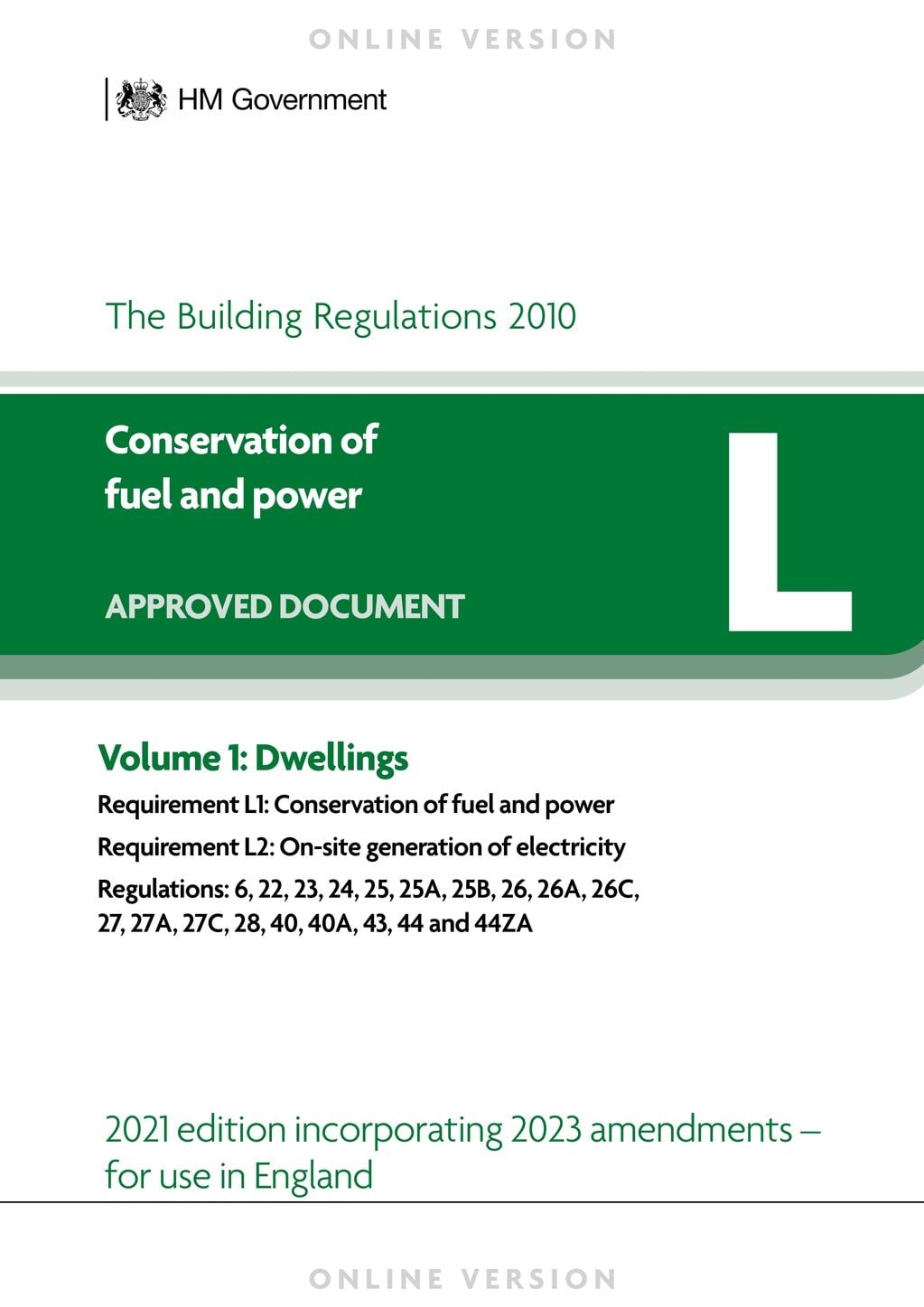
That 2021 uplift is still the current, live standard for new dwellings today. It remains in force until the Future Homes Standard (FHS) comes into effect on 24 March 2027, with a twelve-month transitional window running to 24 March 2028 for plots that have already submitted before the FHS date.
For the full detail on those transitional dates and what FHS itself requires, once Part L 2021 stops being the baseline:
What Part L 2021 Actually Requires
Compliance itself is demonstrated through a SAP calculation – it’s the SAP figure that gets checked against the requirements below, not a separate inspection process.
Fabric energy efficiency
The Fabric Energy Efficiency metric will be improved, with the regulations adopting the ‘full FEES’ target. This will likely require improvements across numerous areas of specification compared to Part L 2013.Part L 2021 adopted the “full FEES” (Fabric Energy Efficiency Standard) target, requiring genuine improvement across most areas of specification compared with the 2013 baseline, rather than a token uplift.The Fabric Energy Efficiency metric will be improved, with the regulations adopting the ‘full FEES’ target. This will likely require improvements across numerous areas of specification compared to Part L 2013.
Primary energy
A primary energy target accounts for a dwelling’s heating system efficiency alongside upstream losses – power station efficiency, fuel transportation and transmission – rather than looking at the dwelling in isolation. This means the fuel source used for space and water heating has a direct bearing on compliance, as does any on-site generation.
U – Values
Minimum U-values for individual thermal elements were tightened as part of the 2021 uplift, and the worst-performing building services – boilers, heat pumps, cooling systems, lighting – can no longer be specified at all.
Thermal bridging
Government-approved generic construction details were withdrawn under Part L 2021. Specific thermal bridging details or bespoke Psi-value calculations are needed to pass the SAP calculation, rather than relying on a standard reference detail.
Air Tightness Under Part L 2021
Sample testing is no longer permitted – every dwelling now requires its own air tightness test, with no exceptions for identical house types on the same site.
The current maximum air permeability target under Part L 2021 is 8 m³/(h·m²) at 50 Pa, a 2-point tightening from the previous 10 m³/(h·m²) maximum. Dwellings achieving 3 m³/(h·m²) or tighter require continuous mechanical ventilation – centralised or decentralised – rather than relying on natural or intermittent extract ventilation alone; passive stack and positive input ventilation were removed from the approved routes altogether under the accompanying Part F update. Fan flow rates themselves weren’t changed by Part L 2021 – it’s the ventilation strategy that shifts as airtightness tightens, not the extract rates.
This is worth being precise about, because it’s a genuinely separate topic from what comes next under FHS and HEM: FHS tightens the notional air permeability target further still, and HEM’s own beta testing has shown an even tighter notional figure again. See our Home Energy Model post for that detail rather than assuming the Part L 2021 figures above still apply once FHS is in force.
SAP and the Part L 2021 Uplift
Part L 2021 was originally paired with the introduction of SAP 10 – a modernisation of the calculation methodology that hadn’t meaningfully changed since 2013, despite the UK electricity grid’s carbon intensity improving substantially over the same period.
SAP has moved on since then. The current version is SAP 10.3, confirmed on the government’s official SAP guidance, which also carries the notional specification for the Future Homes Standard. SAP itself is expected to eventually be replaced by the Home Energy Model (HEM).
One evidence requirement introduced alongside Part L 2021 remains current: a compliance report – commonly referred to as a BREL (Building Regulations England L) report – along with photographic evidence through the build process, addressing the performance gap between design-stage modelling and as-built reality.
Overheating (Part O)
Part L 2021 was accompanied by a new Approved Document O, addressing overheating risk through restrictions on glazing area relative to floor area, with dynamic thermal modelling (CIBSE TM59) available as a compliance route for more complex or heavily-glazed designs. Part O has since become a well-established part of the compliance landscape rather than a new addition.
What’s Next?
Part L 2021 remains the live standard for new dwellings today, but it has a fixed expiry date: 24 March 2027, when the Future Homes Standard takes over. Whether you’re specifying to the current standard or already planning ahead for FHS, an accurate SAP assessment against Part L 2021 is the same first step either way.

If you’d like your current house types tested against Part L 2021 – or want a head start on what the Future Homes Standard will ask for – our team can talk you through both.